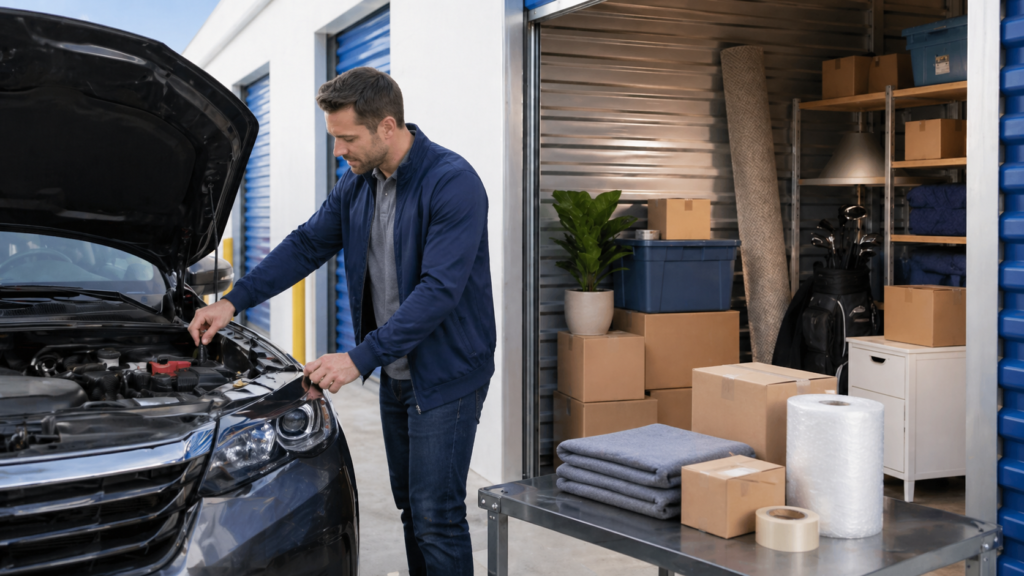
Before storing your vehicle, complete basic maintenance to help protect your investment.
Add a fuel stabilizer to help preserve the fuel in your tank for up to 12 months. Always read the manufacturer’s instructions before adding any product to your vehicle.
Disconnect the battery or connect it to a trickle charger. Most batteries do not store well for long periods, and all batteries discharge over time. Some vehicle storage-sized units may offer power for an additional charge, making a trickle charger a helpful option for maintaining battery life.
Change or top off important fluids, including oil, brake fluid, and antifreeze, before storage.
Never place a dirty or unclean vehicle into long-term storage. Dirt, salt, moisture, and food crumbs can damage finishes, create odors, and attract pests.
Wash and wax the exterior before storing the vehicle.
Vacuum and dust the interior thoroughly. Apply conditioner to vinyl or leather surfaces to help prevent drying, cracking, and odors. If you plan to steam clean the interior, do it far enough in advance so everything can fully dry before storage.
Once the vehicle is inside the storage unit, give the exterior one final wipe down to remove dust, debris, or road salt from transport.
Use a breathable vehicle cover for additional protection while the vehicle is stored.
Tires, brakes, and wipers can be affected when a vehicle sits in one place for an extended period.
To help prevent tire flat spots, consider placing the vehicle on blocks or jack stands if it will be stored for more than a month. Do not use jack stands or blocks if the vehicle is being stored on a car lift.
Release the parking brake before storage to help prevent the brake pads from sticking to the rotors. If using a car lift, make sure the wheels are properly blocked according to the lift instructions.
Place paper or a soft barrier between the windshield wipers and the glass to help prevent the wipers from sticking to the windows.
If your vehicle will be stored for several months, a few additional precautions can help keep it in better condition.
Leave convertible tops up with the windows and vents closed. Convertible tops can develop creases when folded for long periods, especially in colder conditions.
When possible, start and drive the vehicle a short distance every couple of months. This helps keep mechanical and hydraulic components moving and can reduce issues caused by sitting too long.
If you are storing a classic car, specialty vehicle, or any vehicle for more than one year, consult a qualified vehicle specialist for additional recommendations.
Rodents can be a concern any time a vehicle sits unused for an extended period. Take precautions to make the vehicle less inviting.
Cover the exhaust pipe and air intake to help keep rodents from entering the vehicle. Be sure to remove any coverings before starting the vehicle again.
Remove food, trash, paper products, and scented items from the vehicle before storage.
Consider placing traps inside the storage unit to help stop rodents before they reach the vehicle.
Car lifts can be dangerous if they are not used properly. Before using a car lift, read and understand the lift operation manual and follow all instructions carefully.
Facility employees are not permitted to operate car lifts or assist with lift operation. If you use a car lift, you are responsible for operating it safely and maintaining it in good condition. Use of a lift may also affect liability under your rental agreement, so review your agreement carefully before use.
If you are not sure which type of storage is right for you, our team can help. Contact Low Cost Storage today and we will help you find a solution that fits your space, budget, and access needs.
Low Cost Storage has locations serving California and Colorado, with storage options that vary by facility. Each location offers its own mix of unit sizes, access hours, features, vehicle storage options, and customer services.